Brain Based Strategies
These principles focus on how learning happens and how to support effectively. They promote metacognition, deliberate practice, emotional regulation, and learning how to learn.
 TimeToBelieve.
Believe. Improve. Achieve.
... a culture of belief, values and behaviours which enables everyone to improve, believe & achieve.
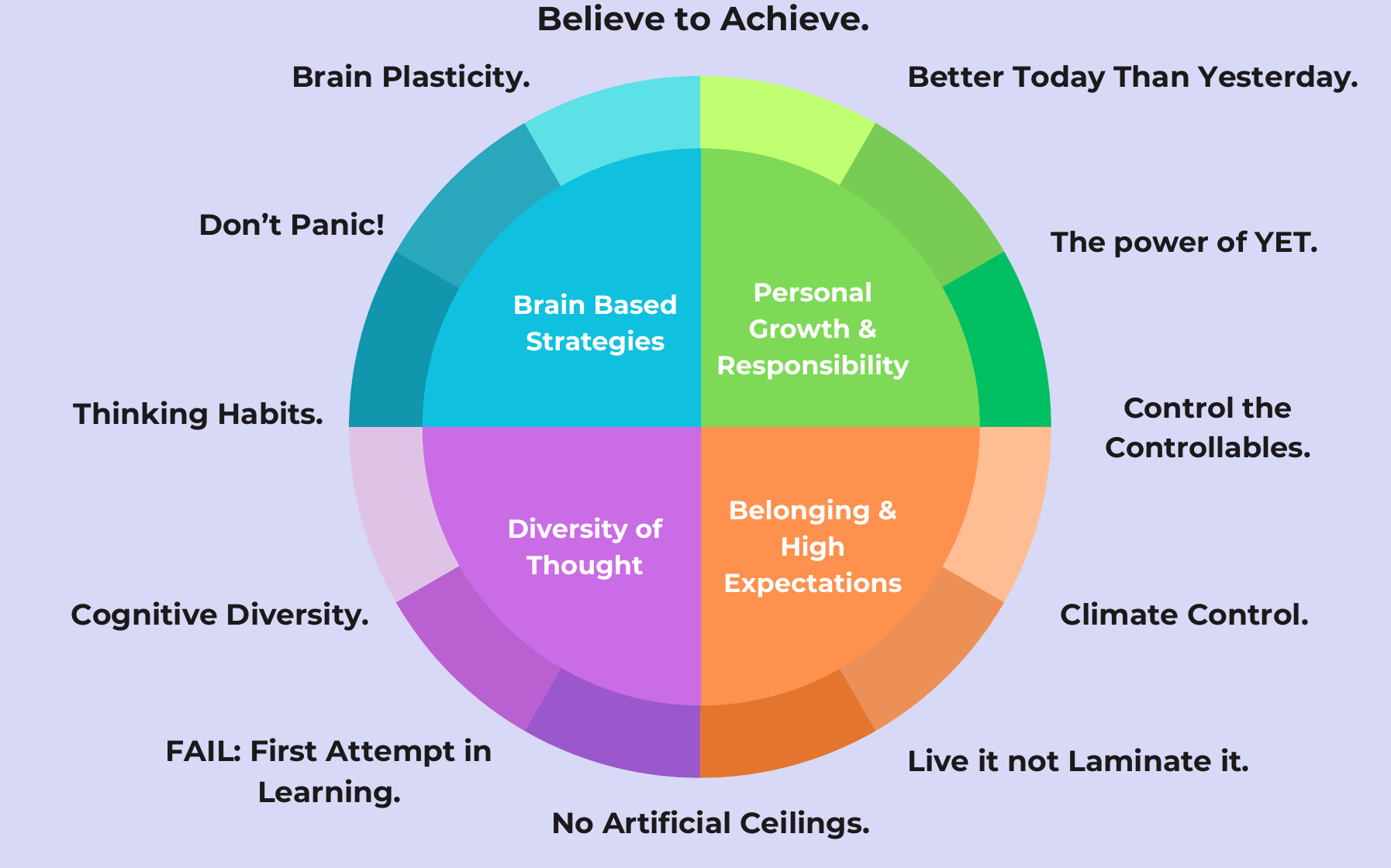
Four connected pathways
These principles focus on how learning happens and how to support effectively. They promote metacognition, deliberate practice, emotional regulation, and learning how to learn.
These principles focus on internal beliefs, motivation and the process of learning through struggle. They nurture perseverance, grit, a belief in self improvement and owning one's learning journey.
These principles focus on creating an inclusive, psychologically safe and high-expectation learning culture. They promote environment, equity and the shared responsibility of staff and pupils.
These principles focus on encouraging creativity, collaboration and multiple perspectives. They value the importance of different ways to think about a problem and group intelligence.
Is there a hierarchy?
Brain Plasticity - Make a Path and Better Today than Yesterday are game changers in shifting the beliefs, values and behaviours of teachers and pupils.
12 Principles
Principle
Use the 'cornfield' analogy to help teachers and pupils understand the concept of making paths in a meaningful way.
Key language and behaviours
Use the 'cornfield' analogy to help teachers and pupils understand the concept of making paths.
Questions
What tasks generate learning / are critical to making secure pathways?
Always follow Rule 1
Believe to Achieve
School leader mode
Rate the school, identify the priority principle, then use the generated agenda and first-term plan with staff, SLT or governors.
Priority principle
The school profile will identify the best starting point.
Staff meeting agenda
Implementation plan
12 Principles
12 principles
Culture lift
Start with the likely difference this principle can make to beliefs, values and behaviours.
Ease and time
Balance what can begin now with what needs deliberate embedding over the term or year.
Look beneath the average
Use the self evaluation profile, classroom questions and context before choosing a move.
Better Today Than Yesterday
Culture lift
Transformational
Ease
Low effort
Time
Now
Confidence
Strong
Encourage pupils to focus and celebrate on their own progress, however small, and not the progress of others.
Where this works best
Feedback focuses on self-improvement not attainment.
Implementation steps
Common mistakes
Always follow Rule 1.
Control the Controllables
Culture lift
Strong
Ease
Low effort
Time
Now
Confidence
Strong
Encourage all pupils to be active participants in the classroom.
Where this works best
All pupils are encouraged to be active participants in the classroom.
Implementation steps
Common mistakes
Do nothing as an option.
The Power of YET
Culture lift
Strong
Ease
Low effort
Time
Now
Confidence
Strong
Change the language to remove any fixed mindset inner voice e.g. 'I can't do this', to 'I can do this if I keep practising'.
Where this works best
Change the language to remove any fixed mindset inner voice.
Implementation steps
Common mistakes
Fixed mindset inner voice. Ability as fixed.
Climate Control
Culture lift
Transformational
Ease
Medium effort
Time
This Term
Confidence
Strong
Assess and evaluate the 'weather' in the classroom.
Where this works best
The teacher's personal approach creates the climate in a classroom.
Implementation steps
Common mistakes
Underestimate their power of influence.
Live it not Laminate it
Culture lift
Transformational
Ease
Medium effort
Time
This Term
Confidence
Strong
Continually promote the 12 YesUCan principles through the use of key language and behaviours.
Where this works best
All staff continually promote the 12 YesUCan principles through the use of key language and behaviours.
Implementation steps
Common mistakes
Policy compliance. Policies, procedures or posters.
No Artificial Ceilings
Culture lift
Transformational
Ease
Medium effort
Time
This Term
Confidence
Strong
Give pupils the same learning opportunities.
Where this works best
Pupils have a sense of belonging in the classroom when given the same learning opportunities.
Implementation steps
Common mistakes
Lowers, less able, highers, the red group, bottom set, nurture set.
FAIL: First Attempt in Learning
Culture lift
Strong
Ease
Low effort
Time
Now
Confidence
Strong
Celebrate making mistakes as a key part of new learning.
Where this works best
Celebrate making mistakes as a key part of new learning.
Implementation steps
Common mistakes
Mistakes made but not discussed or corrected.
Cognitive Diversity
Culture lift
Strong
Ease
Medium effort
Time
This Term
Confidence
Strong
Celebrate and champion diverse ways of thinking.
Where this works best
Different ways of thinking about a problem are valued and championed.
Implementation steps
Common mistakes
Group think. Fixed ways of thinking.
Thinking Habits
Culture lift
Strong
Ease
Medium effort
Time
This Term
Confidence
Strong
Encourage and champion pupils to be guessers, describers, tinkerers, visualisers, conjecturers, pattern sniffers, experimenters and inventors.
Where this works best
Encourage and champion pupils to be guessers, describers, tinkerers, visualisers, conjecturers, pattern sniffers, experimenters and inventors.
Implementation steps
Common mistakes
Pupils not safe sharing their thinking in the classroom.
Don't Panic!
Culture lift
Strong
Ease
Medium effort
Time
Now
Confidence
Strong
Stay in the growth zone and out of the anxiety zone.
Where this works best
Establish a culture where pupils understand and expect to be pushed out of their comfort zone as part of the learning process.
Implementation steps
Common mistakes
Do pupils give up too easily?
Brain Plasticity
Culture lift
Transformational
Ease
Medium effort
Time
This Term
Confidence
Strong
Use the 'cornfield' analogy to help teachers and pupils understand the concept of making paths.
Where this works best
Pupils understanding the basic biology of the brain realise why it's important to build from existing knowledge.
Implementation steps
Common mistakes
One walk through may be hard and will flatten some growth, but it will quickly disappear if effort is not put into revisiting the path.
Believe to Achieve
Culture lift
Transformational
Ease
Low effort
Time
Now
Confidence
Strong
Capture and celebrate case studies of how individual pupils are better today than yesterday.
Where this works best
Capturing and celebrating case studies of how individual pupils are better today than yesterday is critical to transforming values, beliefs and behaviours.
Implementation steps
Common mistakes
A process not an event.
Embedding the Principles
Classroom prompt
Do all staff and pupils believe they have the growth mindset that they can be better today than yesterday?
Teacher move
Encourage pupils to focus and celebrate on their own progress, however small, and not the progress of others.
Pupil reflection
Better today than yesterday. Believe. Improve. Achieve.
Quick activity
Feedback focuses on self-improvement not attainment.
Believe to Achieve
Stay in the growth zone and out of the anxiety zone. We learn best if we are cool, calm and collected.
Key language and behaviours
Stay in the growth zone and out of the anxiety zone.
Questions
Do pupils give up too easily? Is this an accepted behaviour?